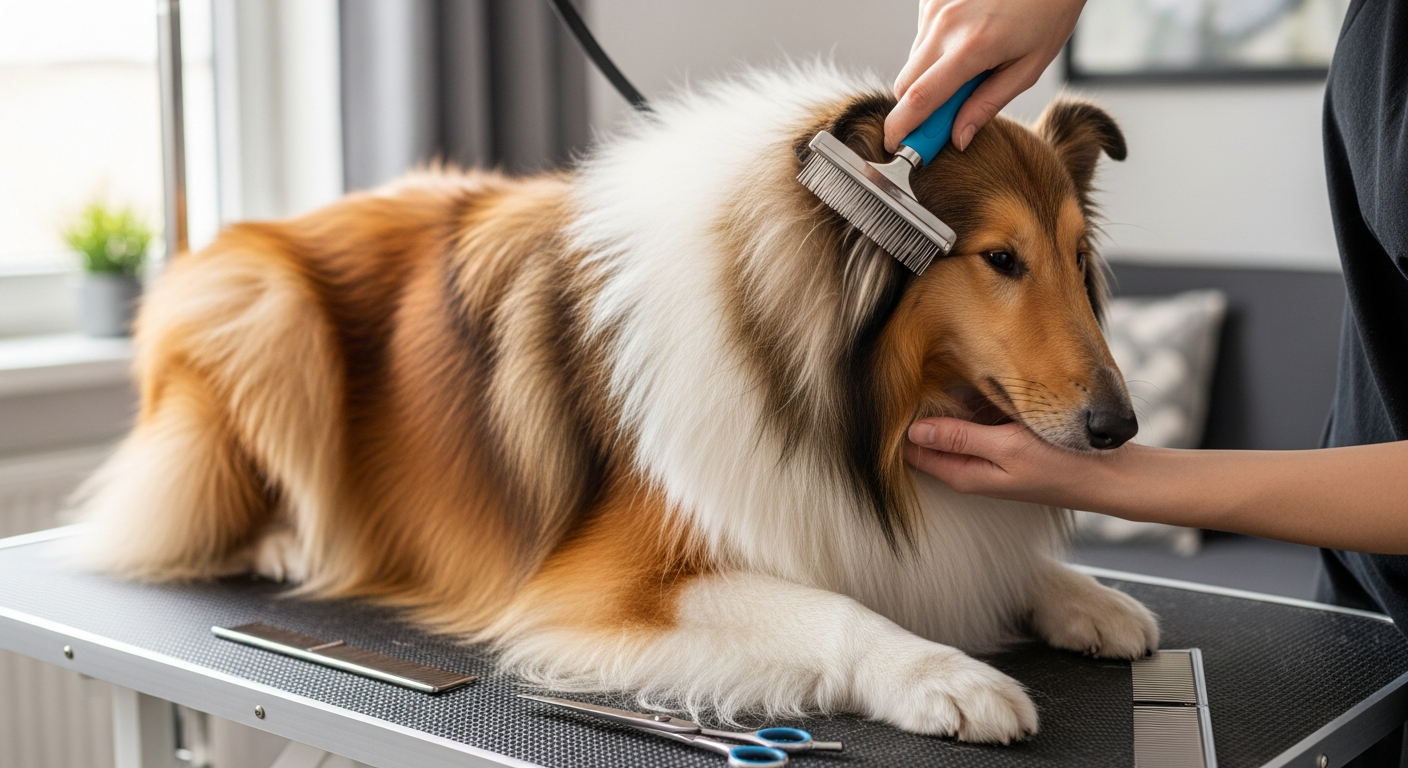
Every spring and every fall, my kitchen floor looks like it is trying to grow a second Cooper. Collie coats do this; the double coat is part of what protects them from cold, heat, and sun, and twice a year the undercoat releases in what groomers politely call “coat blow.” The undercoat tool market knows this and has responded with approximately 4,000 products promising to solve it. Most of them fail, damage the top coat, or both. Here is what I actually reach for after two full shedding seasons of testing.
The Short Version
- Primary tool: Metal undercoat rake with rotating teeth (Chris Christensen Mark V or equivalent)
- Finishing tool: Soft slicker brush (Chris Christensen Big K or Safari pin brush for less hair loss)
- For stubborn mats: Detangling comb (stainless steel greyhound comb)
- What I stopped using: Furminator, any blade-style deshedder, cheap plastic slickers
Below is the detail on why, and how to actually use these tools without damaging the coat your dog needs.
Why the Top Coat Matters
Before we talk tools, the single most important thing to understand about grooming a Collie: the top coat (guard hairs) is protective. Guard hairs insulate against sun, heat, and cold, wick moisture away, and protect the skin from UV damage. A correctly groomed Collie has the undercoat removed and the top coat intact. A badly groomed Collie has been shaved or furminated down to an even, short coat that looks tidy and is actually harming the dog.
The reason this matters is that blade-style deshedders (Furminator being the most famous) cut the top coat along with pulling undercoat. Over multiple sessions, this thins the guard hairs and leaves the coat visibly different, often with a dull or frizzy appearance. Once the top coat is damaged, it takes months to grow back and the dog loses the protective function in the meantime. Our companion guide, grooming tools essentials, expands on tools that protect the coat rather than damage it.
The Undercoat Rake (Main Tool)
An undercoat rake is a long-toothed metal tool designed to glide through the top coat and grab the loose undercoat underneath. The teeth are usually rounded at the tips to prevent scratching the skin.
The Chris Christensen Mark V ($45) is the tool I recommend without reservation. The teeth rotate slightly, which prevents the tool from catching and pulling. The handle is comfortable for longer sessions. Used with a pulling-through motion rather than a digging motion, it extracts enormous amounts of undercoat in minutes during shedding season without touching the top coat. After two years and dozens of sessions, my Mark V still performs identically to day one.
Cheaper alternatives that work adequately: the Safari Undercoat Rake ($15) does the same job with less finesse. The teeth do not rotate, so you have to be more careful about pulling rather than scraping.
Technique matters more than tool choice. Pull the rake through the coat in the direction the hair grows, with the teeth angled about 45 degrees into the coat. Work in small sections, top to bottom along the dog’s sides, then along the hindquarters, then the shoulders. Do not press down; let the tool do the work. Sessions should last 15 to 20 minutes at peak shedding, once every 3 days during coat blow.
The Slicker Brush (Finishing)
After the rake removes bulk undercoat, a slicker brush finishes the job and keeps the top coat smooth. The Chris Christensen Big K ($30) has the right stiffness for a heavy Collie coat without breaking guard hairs. The Safari pin brush ($12) is gentler and what I use on my neighbor’s Sheltie who has a finer coat.
The Hertzko self-cleaning slicker that dominates the Amazon listings is adequate but the wires are too short for the depth of a Collie coat. They work fine on flat-coated breeds. For a long-coated herding dog, spend the extra $18 on the Big K.
The Detangling Comb
Mats happen. Behind the ears, under the collar, in the britches. A stainless steel greyhound comb ($15) is the best tool for working them out gently without cutting. Pick apart mats with your fingers first, then work the comb from the tips of the mat inward toward the skin, never yanking. If a mat is tight to the skin, a groomer’s splitter or actual scissoring done carefully is safer than forcing a comb through.
The Canine Chiropractic Guild and several professional groomers recommend that owners do not attempt to cut mats out with scissors unless they are very confident about skin location. The tension from a mat pulls the skin up underneath, which is why scissor injuries happen.
What I Stopped Using
The Furminator. It works. It removes undercoat. It also cuts top coat. After one full shedding season of Furminator use early in my Collie journey, Cooper’s coat looked obviously different: shorter, flatter, less shiny, and the guard hairs had visible blunt ends. Multiple breeders and one respected groomer confirmed what I suspected. The Furminator is a blade-style tool, and blades cut hair. It is marketed as a non-cutting “deshedding tool,” but physics does not lie.
Plastic slickers. They bend, they lose wires, and they do not reach through a double coat effectively. Save your money.
Shedding blades (horse blade style). These scrape along the coat and break guard hairs. They work on short-coated breeds. They do not belong near a Collie.
Grooming gloves. Cute but useless on a heavily shedding double coat. They are fine as a finishing touch or for dogs that will not tolerate a brush at all, but they are not a primary tool.
When to See a Professional
Coat blow in a Collie is manageable at home if you have the tools and the time. If your dog has matted to the skin, has refused grooming for months and is now a walking dreadlock, or has a skin condition that makes brushing painful, a groomer is the right call. A “line brush and bath” from a professional experienced with double coats costs $80 to $150 and can reset the coat in one session. They have high-velocity dryers that blow out the undercoat in ways no home tool can match.
If you want to explore more of what I use for a Collie, our health and wellness products and grooming essentials articles cover the rest of the routine.
Seasonal Timing
Spring coat blow in my area (northern Illinois) starts around mid-March and finishes by late May. Fall coat blow runs late September through mid-November. Outside of those two windows, Cooper gets a full brush-through once a week (20 minutes), which keeps the coat in good condition without becoming a chore. Inside the windows, it is every 2 to 3 days with full sessions.
The AKC’s guide to dog shedding is a useful reference for seasonal patterns and why brushing actually reduces shedding on furniture (loose hair caught on the tool instead of the couch).
Bottom Line
Two tools handle 90 percent of Collie grooming: a Chris Christensen Mark V undercoat rake and a good slicker brush. Add a greyhound comb for mats, resist the urge to buy a Furminator, and brush through shedding season on a regular cadence. Your dog keeps its protective coat, your house stays marginally cleaner, and you save several hundred dollars compared with the gadget-heavy approach.